





30 sections, Oct 25 – May 18, 2027 · Mondays, Tuesdays, Wednesdays, Thursdays & Fridays · Grades K–12 · $105–$196
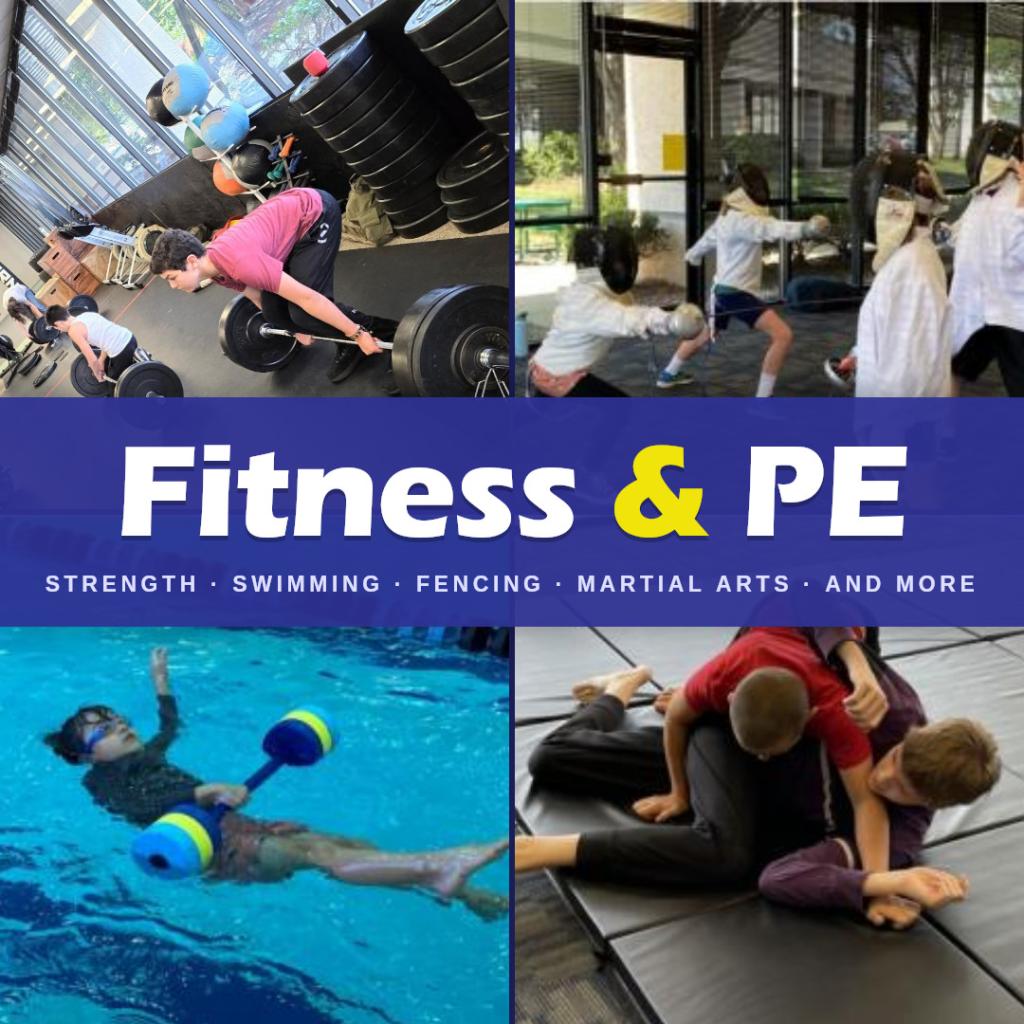
From FUNctional Fitness and teen weight training to swimming, fencing, gymnastics and martial arts: every way to move at Compass, for every age. Find your student’s grade below and add a section to your cart.
Fun Fit (PE) for Little Kids
Read more about Fun Fit (PE) for Little Kids
Fun Fit PE encourages young elementary schoolers to move and play during the day! Kids will enjoy games such as flag tag, tug-of-war, soft dodge ball, relays, and silly obstacle courses with challenges such as crab crawl, log roll, or bunny hop. Activities will engage hand-eye coordination, gross motor skills and improve accuracy, endurance, speed, agility, and flexibility.
Fun Fit PE is a fun, supportive, small-group experience with a dedicated coach where the emphasis is on doing one's best and individual improvement rather than competition or comparison with classmates. Equally as important, young athletes get to practice valuable life skills such as working with teammates, good sportsmanship, taking turns, cooperation, and communicating with the coach.
All activities will take place on the thick mats of Compass's new physical fitness center. Children will play in socks or bare feet as shoes cannot be worn on the mats. They should wear loose, comfortable clothing and bring a reusable water bottle.
The color name in the class title refers to the collectable token students will earn each quarter they take the class. Collect all 8! Children may enroll in Fun Fit PE at any time, regardless of the color name No one color is a prerequisite for any other color, and tokens can be earned in any order.
Junior Gymnastics: Beam Basics
Read more about Junior Gymnastics: Beam Basics
Tumble, turn, twist, and twirl! Junior Gymnastics is a beginner-level class designed to support the development of motor skills in children while introducing beginning athleticism through gymnastics. This class incorporates fundamental movements like hopping, skipping, jumping, and balancing while building strength, flexibility and coordination. Gymnastics encourages children to explore their body's movement through play and exercise.
Each session will include warm-up activities, cool-down exercises, and fun play with props like parachutes, while each quarter has a different gymnastics focus. Second quarter "Beam Basics" introduces balance and coordination on a low, 6" balance beam. All work will be done on padded floor mats and portable equipment on loan from the instructor's gymnastics school.
Students should wear workout attire, but preferably not lose or floppy clothing. Students with long hair are asked to tie their hair back. Students will play and exercise in socks, so they should not come in sandals, crocs, or slides.
Topics in this series include: Floor Fun (Quarter 1), Beam Basics (Quarter 2), Vault Ventures (Quarter 3), and Rhythmic Routines (Quarter 4).

Swimming: Beginners/ Adv. Beginners
Read more about Swimming: Beginners/ Adv. Beginners
Homeschool Swim Lessons are taught at the Reston YMCA located 0.9 miles/ 3 minute drive from Compass's classroom facility. For more information on swimming lessons, see the program webpage.
During the first lesson, students will be observed and determined to be Beginner or Advanced Beginner level, and the class will be divided accordingly among two instructors. Beginners level is for students with little to no swim experience and will cover YMCA Level 1 skills such as water acclimation, floatation, water movement, putting face in the water, swimming 5 feet without a floatation device, and becoming comfortable on back in water. Advanced Beginners level will review all skills in beginner-level class and add YMCA Level 2 skills such as stamina, swimming one length of the pool (25 yards), performing elementary backstroke, rotary breathing, becoming comfortable in deep water, and stroke introduction to include: front crawl, backstroke, and elementary breaststroke.
Please note that these skills will be introduced and progress at different rates depending on the comfortable level and experience of enrolled students and may take more than one quarter to complete. At times, students might be moved to a different swimming group (same day, same time, different instructor) to better match the experience level of enrolled children.
Lessons are 40 minutes long, running from 0:05 until 0:45 after the hour, leaving enough time to towel dry, change clothes, and return to Compass for your next class. Students should bring a swimsuit, towel, and change of clothes. Googles and swim caps are optional.
A parent (or parent proxy) is required to remain on site. Parents may wait on poolside benches or lobby seating. YMCA waivers must be signed and returned for each swimmer. All registration is completed through Compass. All YMCA swimming classes are taught by certified, experienced, background-checked adult instructors with experience teaching children.
Consider enrolling your child in both Tuesday and Thursday classes to improve their rate of learning.
Fencing for Young Beginners
Read more about Fencing for Young Beginners
Fencing is the clashing of steel and competitive spirit combined with the battle of the wits. Apply the rules of Olympic fencing, and you have a physically and mentally challenging game of strategy, often called, "physical chess."
In Beginning Fencing, students will learn the rules of the sport as well as footwork, attacks, parries, responses, and how to judge matches. Beginning students will use the epee, a thin, lightweight sword with broad hand guard and will wear a wireless electronic scoring sensor over layers of protective gear. Returning students will work with both the epee and foil.
The physical benefits of fencing are an increase in agility, balance and coordination. Fencing also provides mental benefits such as improved focus, strategy and confidence. Fencing is safety-oriented with blunt tip weapons, chest protectors, chest/sleeve pads, fencing jacket, gloves, and face mask.
Students may enroll any quarter. All equipment is provided by the instructor. Students are asked to wear full length, comfortable athletic pants such as running pants or sweatpants (no jeans, no shorts, no dresses or skirts), and low-heeled athletic shoes.
Swimming: Intermediate
Read more about Swimming: Intermediate
Homeschool Swim Lessons are taught at the Reston YMCA located 0.9 miles/ 3 minute drive from Compass's classroom facility. For more information on swimming lessons, see the program webpage.
Intermediate level is for students who are proficient in Advanced Beginner level skills such as swimming one length of the pool (25 yards), performing elementary backstroke, and becoming comfortable in deep water. Intermediate swimmers will cover Levels 3 of the YMCA program including elementary breaststroke, backstroke, front crawl with rotary breathing all at 25 yards, with work towards Level 4 skills including stamina and increasing all swimming to 50 yards or more, plus breast stroke, elementary butterfly stroke and kick, elementary dives, and turns.
Please note that these skills will be introduced and progress at different rates depending on the comfortable level and experience of enrolled students and may take more than one quarter to complete. At times, students might be moved to a different swimming group (same day, same time, different instructor) to better match the experience level of enrolled children.
Lessons are 40 minutes long, running from 0:05 until 0:45 after the hour, leaving enough time to towel dry, change clothes, and return to Compass for your next class. Students should bring a swimsuit, towel, and change of clothes. Googles and swim caps are optional.
A parent (or parent proxy) is required to remain on site. Parents may wait on poolside benches or lobby seating. YMCA waivers must be signed and returned for each swimmer. All registration is completed through Compass. All YMCA swimming classes are taught by certified, experienced, background-checked adult instructors with experience teaching children.
Consider enrolling your child in both Tuesday and Thursday classes to improve their rate of learning.
FUNctional Fitness and Cross-Training (PE) for Kids
Read more about FUNctional Fitness and Cross-Training (PE) for Kids
FUNctional Fitness is a dynamic PE program for that incorporates well-rounded exercises to get tweens up and moving mid-day! No two workouts are the same, but each day's activities incorporate exercises that target 10 areas: cardio-vascular endurance, stamina, strength, flexibility, power, speed, coordination, agility, balance, and accuracy. FUNctional Fitness focuses on functional movements that are fundamental to all aspects of play and exercise- pulling, pushing, running, throwing, climbing, lifting, and jumping. Work-outs are scalable and adaptable to different individual's own level, and the emphasis is on fun, safety, and personal accomplishment rather than competition among classmates. When the weather permits, some exercises may be taken outdoors. The physical challenges of FUNctional Fitness will foster self-confidence, focus, and help instill a foundation for a lifetime of fitness.
The color name in the class title refers to the collectable token students will earn each quarter they take the class. Collect all 8! Students may enroll in FUNctional Fitness at any time, regardless of the color name No one color is a prerequisite for any other color, and tokens can be earned in any order.
All equipment is furnished. Students are asked to wear loose, comfortable clothing, such as running pants or sweatpants, and comfortable, supportive athletic shoes. FUNctional Fitness continues each quarter, and students may repeat the class to continue to improve fitness. No two workouts are the same!
Jiu Jitsu Junior
Read more about Jiu Jitsu Junior
Jiu-Jitsu Fit is a fun, interactive, physical fitness program for tweens incorporating the Brazilian self-defense martial art of Jiu-Jitsu. Students will follow a well-rounded physical fitness program that incorporates moves and strategies of Jiu-Jitsu to increase strength, flexibility, conditioning, endurance, coordination, balance, and fun! Students will practice techniques for resolving conflicts, dealing with bullies, projecting confidence, and developing stranger awareness in the games and exercises they complete in class. Jiu-Jitsu Fit helps tweens stay active, builds self-esteem, and encourages teamwork. Jiu-Jitsu uses grappling and ground work in addition to standing self-defense positions.
The color name in the class title refers to the collectable token students will earn each quarter they take the class. Collect all 8! Students may enroll in Jiu Jitsu Fit at any time, regardless of the color name No one color is a prerequisite for any other color, and tokens can be earned in any order.
Some partner work may be co-ed. Students will work on mats in socks or bare feet and should come to class wearing loose, comfortable clothing, such as running pants or sweatpants and bring a refillable water bottle.
Power-Up Parkour for Kids
Read more about Power-Up Parkour for Kids
Ready to leap, vault, and move like a real-life ninja or superhero? In this action-packed parkour class, students learn to tackle obstacles with speed, control, and confidence as they run, jump, and climb through structured challenges. Along the way, they build strength, coordination, and focus while channeling big energy into smart, controlled movement.
All equipment is furnished. Students are asked to wear loose, comfortable clothing, such as running pants or sweatpants, and comfortable, supportive athletic shoes. Sandals, crocs, flip-flops or slides may not be worn. Power-Up Parkour continues each quarter, and students may repeat the class to continue to improve fitness and agility. No two workouts are the same!
Fencing for Beginners & Advanced Beginners
Read more about Fencing for Beginners & Advanced Beginners
Fencing is the clashing of steel and competitive spirit combined with the battle of the wits. Apply the rules of Olympic fencing, and you have a physically and mentally challenging game of strategy, often called, "physical chess."
In Beginning Fencing, students will learn the rules of the sport as well as footwork, attacks, parries, responses, and how to judge matches. Beginning students will use the epee, a thin, lightweight sword with broad hand guard and will wear a wireless electronic scoring sensor over layers of protective gear. Returning students will work with both the epee and foil.
The physical benefits of fencing are an increase in agility, balance and coordination. Fencing also provides mental benefits such as improved focus, strategy and confidence. Fencing is safety-oriented with blunt tip weapons, chest protectors, chest/sleeve pads, fencing jacket, gloves, and face mask.
Students may enroll any quarter. All equipment is provided by the instructor. Students are asked to wear full length, comfortable athletic pants such as running pants or sweatpants (no jeans, no shorts, no dresses or skirts), and low-heeled athletic shoes.
Krav Maga Self Defense for Kids
Read more about Krav Maga Self Defense for Kids
Krav Maga is the Israeli martial art which teaches self defense and fitness. Students of Krav Maga are taught a series of strategies to assess and respond to common situations, such as facing a bully. Kids are always taught first and foremost to get away, to get help, and to try to deescalate the situation. When that fails, students practice a technique that includes a warning strike followed by escape, and finally, they learn how to stand up for themselves and how to counterattack if a situation escalates and becomes threatening. Kids are empowered and gain confidence when they rehearse how to handle real-life situations. Exercises and in-class practice incorporate balance, coordination, energy, and other key elements of fitness along with life skills such as confidence, teamwork, respect, discipline, and respect.
Students may enroll in Krav Maga at any time, and everyone will begin as a white belt. Each quarter, students will practice the full range of skills, but there will be two "featured" moves that a student can earn a belt stripe for being able to demonstrate. Featured moves will include a combative strike and a defensive escape technique. No one stripe is a prerequisite for any other color, and color stripes can be earned in any order.
Second quarter, students will have the chance to earn a Purple Stripe. The featured moves include:
- Red Stripe
- 360 Defense and Headlock Release
- OrangeStripe
- Inside Defense and Release from Front Choke
- Yellow Stripe
- Using Your Environment and Wrist Grab Releases
- Green Stripe
- Kick Defense and Ground Choke Release
- Blue Stripe
- Body Defense and Shirt Grab Releases
- Purple Stripe
- Protecting Others and Ground Headlock Release
- Brown Stripe
- Ground Strike Defenses and Bearhug Releases
- Black Stripe
- Ground Kick Defenses and Back Choke Releases
Students will be able to test for belt promotions to move through the ranks of white belt, yellow belt, orange belt, etc. On average, it is estimated that a student will be ready for a belt test after four quarters/four color stripes. Belt testing will be by coach approval.
What to Bring: Refillable water bottle.
What to Wear: In lieu of a full martial arts uniform, participants should wear their class t-shirt and belt along with shorts, leggings, or loose, comfortable athletic pants, and comfortable athletic shoes or sneakers.
Topics in this Series: Blue Stripe (1st Quarter), Purple Stripe (2nd Quarter), Brown Stripe (3rd Quarter) and Black Stripe (4th Quarter).
FUNctional Fitness and Cross-Training (PE) for Tweens
Read more about FUNctional Fitness and Cross-Training (PE) for Tweens
FUNctional Fitness is a dynamic PE program for that incorporates well-rounded exercises to get tweens up and moving mid-day! No two workouts are the same, but each day's activities incorporate exercises that target 10 areas: cardio-vascular endurance, stamina, strength, flexibility, power, speed, coordination, agility, balance, and accuracy. FUNctional Fitness focuses on functional movements that are fundamental to all aspects of play and exercise- pulling, pushing, running, throwing, climbing, lifting, and jumping. Work-outs are scalable and adaptable to different individual's own level, and the emphasis is on fun, safety, and personal accomplishment rather than competition among classmates. When the weather permits, some exercises may be taken outdoors. The physical challenges of FUNctional Fitness will foster self-confidence, focus, and help instill a foundation for a lifetime of fitness.
The color name in the class title refers to the collectable token students will earn each quarter they take the class. Collect all 8! Students may enroll in FUNctional Fitness at any time, regardless of the color name No one color is a prerequisite for any other color, and tokens can be earned in any order.
All equipment is furnished. Students are asked to wear loose, comfortable clothing, such as running pants or sweatpants, and comfortable, supportive athletic shoes. FUNctional Fitness continues each quarter, and students may repeat the class to continue to improve fitness. No two workouts are the same!
Jiu Jitsu Fit for Tweens
Read more about Jiu Jitsu Fit for Tweens
Jiu-Jitsu Fit is a fun, interactive, physical fitness program for tweens incorporating the Brazilian self-defense martial art of Jiu-Jitsu. Students will follow a well-rounded physical fitness program that incorporates moves and strategies of Jiu-Jitsu to increase strength, flexibility, conditioning, endurance, coordination, balance, and fun! Students will practice techniques for resolving conflicts, dealing with bullies, projecting confidence, and developing stranger awareness in the games and exercises they complete in class. Jiu-Jitsu Fit helps tweens stay active, builds self-esteem, and encourages teamwork. Jiu-Jitsu uses grappling and ground work in addition to standing self-defense positions.
The color name in the class title refers to the collectable token students will earn each quarter they take the class. Collect all 8! Students may enroll in Jiu Jitsu Fit at any time, regardless of the color name No one color is a prerequisite for any other color, and tokens can be earned in any order.
Some partner work may be co-ed. Students will work on mats in socks or bare feet and should come to class wearing loose, comfortable clothing, such as running pants or sweatpants and bring a refillable water bottle.
Teen Weight Training
Read more about Teen Weight Training
Teen weight training is an introduction to strength training in a small group class under the guidance of a seasoned, experienced coach. The primary lifts covered in class will be: back squat, bench press, deadlift, and strict press which are all compound moves that employ multiple muscle groups. These lifts are also "functional" meaning they engage the core and train muscles to work cooperatively in daily activities such as picking up a box or hoisting a parcel to a high shelf. Emphasis will be on correct form, posture, and safety.
The color name in the class title refers to the collectable token students will earn each quarter they take the class. Collect all 8! Teens may enroll in Weight Training at any time, regardless of the color name. No one color is a prerequisite for any other color, and tokens can be earned in any order.
All equipment is furnished. Students are asked to wear loose, comfortable clothing, such as running pants or sweatpants, and comfortable, supportive athletic shoes. Teen Weight Training continues each quarter, and students may repeat the class to continue to improve strength.
Total Training: Teen PE
Read more about Total Training: Teen PE
Total Training is a dynamic PE program for that incorporates well-rounded exercises to get teens moving mid-day! No two workouts are the same, but each day's activities incorporate exercises that target 10 areas: cardio-vascular endurance, stamina, strength, flexibility, power, speed, coordination, agility, balance, and accuracy. Total Training focuses on functional movements that are fundamental to all aspects of play and exercise- pulling, pushing, running, throwing, climbing, lifting, and jumping. Work-outs are scalable and adaptable to different individual's own level, and the emphasis is on fun, safety, and personal accomplishment rather than competition among classmates. The physical challenges of Total Training will foster self-confidence, focus, and help instill a foundation for a lifetime of fitness.
The color name in the class title refers to the collectable token students will earn each quarter they take the class. Collect all 8! Teens may enroll in Total Training at any time, regardless of the color name No one color is a prerequisite for any other color, and tokens can be earned in any order.
All equipment is furnished. Students are asked to wear loose, comfortable clothing, such as running pants or sweatpants, and comfortable, supportive athletic shoes. Total Training continues each quarter, and students may repeat the class to continue to improve fitness. No two workouts are the same!
BoxFit for Teens
Read more about BoxFit for Teens
This boxing fundamentals class helps teens build coordination, confidence, and controlled athletic movement in a safe and structured environment.
Students will learn proper boxing stance and footwork, practice space awareness and movement control, and develop correct punching mechanics through guided drills. Conditioning exercises will improve balance, focus, and overall fitness while building strength and endurance.
All power punches are directed only at heavy bag- never at another student. Students will practice shadow sparring, a non-contact drill that focuses on movement, timing, and technique rather than striking an opponent.
Safety is a top priority. There will be no head contact, no hard punches to the body, and no student-to-student striking of any kind. The class emphasizes discipline, self-control, and skill development rather than aggression.
BoxFit for Teens offers a positive outlet for energy while helping students improve coordination, fitness, and confidence in a supportive, supervised setting.
The color name in the class title refers to the collectable token students will earn each quarter they take the class. Collect all 8! Teens may enroll in Total Training at any time, regardless of the color name No one color is a prerequisite for any other color, and tokens can be earned in any order.
All equipment is furnished. Students are asked to wear loose, comfortable clothing, such as running pants or sweatpants, and comfortable, supportive athletic shoes. BoxFit continues each quarter, and students may repeat the class to continue to improve fitness. No two workouts are the same!
Krav Maga Self Defense for Teens
Read more about Krav Maga Self Defense for Teens
Krav Maga is the Israeli martial art which teaches self defense and fitness. Students of Krav Maga are taught a series of strategies to assess and respond to common situations, such as facing a bully. Kids are always taught first and foremost to get away, to get help, and to try to deescalate the situation. When that fails, students practice a technique that includes a warning strike followed by escape, and finally, they learn how to stand up for themselves and how to counterattack if a situation escalates and becomes threatening. Kids are empowered and gain confidence when they rehearse how to handle real-life situations. Exercises and in-class practice incorporate balance, coordination, energy, and other key elements of fitness along with life skills such as confidence, teamwork, respect, discipline, and respect.
Students may enroll in Krav Maga at any time, and everyone will begin as a white belt. Each quarter, students will practice the full range of skills, but there will be two "featured" moves that a student can earn a belt stripe for being able to demonstrate. Featured moves will include a combative strike and a defensive escape technique. No one stripe is a prerequisite for any other color, and color stripes can be earned in any order.
Second quarter, students will have the chance to earn a Purple Stripe. The featured moves include:
- Red Stripe
- 360 Defense and Headlock Release
- OrangeStripe
- Inside Defense and Release from Front Choke
- Yellow Stripe
- Using Your Environment and Wrist Grab Releases
- Green Stripe
- Kick Defense and Ground Choke Release
- Blue Stripe
- Body Defense and Shirt Grab Releases
- Purple Stripe
- Protecting Others and Ground Headlock Release
- Brown Stripe
- Ground Strike Defenses and Bearhug Releases
- Black Stripe
- Ground Kick Defenses and Back Choke Releases
Students will be able to test for belt promotions to move through the ranks of white belt, yellow belt, orange belt, etc. On average, it is estimated that a student will be ready for a belt test after four quarters/four color stripes. Belt testing will be by coach approval.
What to Bring: Refillable water bottle.
What to Wear: In lieu of a full martial arts uniform, participants should wear their class t-shirt and belt along with shorts, leggings, or loose, comfortable athletic pants, and comfortable athletic shoes or sneakers.
Topics in this Series: Blue Stripe (1st Quarter), Purple Stripe (2nd Quarter), Brown Stripe (3rd Quarter) and Black Stripe (4th Quarter).